
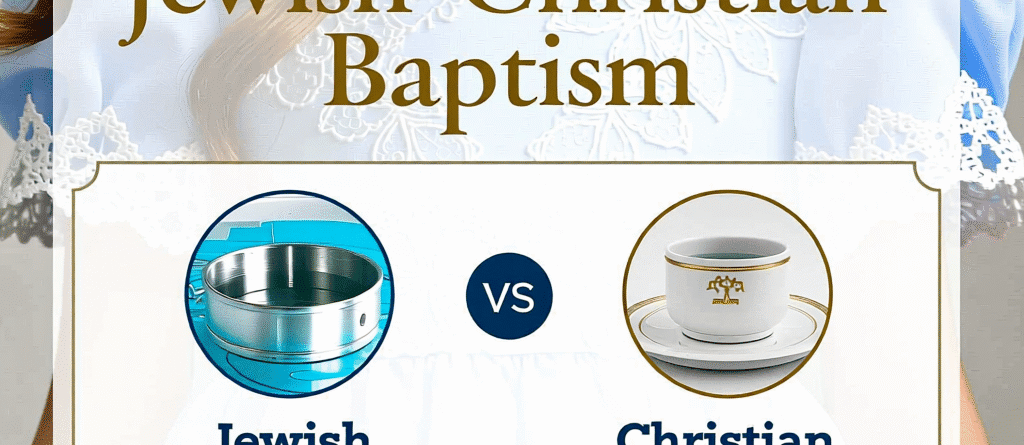
Water is an ancient storyteller. From the brim of a desert river to the quiet pool hidden in a synagogue courtyard, immersion and sprinkling, washing and anointing have long marked moments of passage, purification, and identity. Across Judaism and Christianity, rites involving water carry deep symbolic weight-but they do not all mean the same thing. What looks like a single act can be a covenantal entry, a physical and spiritual cleansing, a sign of communal belonging, or a personal declaration of faith.
This article will map those convergences and contrasts. We will trace Jewish practices such as the mikveh and ritual washings, then turn to the varied baptisms of Christianity-infant and believer’s baptism, modes of immersion, pouring, or sprinkling, and the distinct emphasis on repentance, initiation, or spiritual indwelling. Along the way, we’ll situate these rites in their historical and theological contexts, paying attention to how customs evolved and what they mean for communities today. The goal is not to judge but to illuminate how two closely related traditions have shaped and been shaped by the same elemental symbol: water.
Table of Contents
- Shared Waters, Divergent Meanings: Tracing the Historical Roots of Mikveh and Christian Baptism
- Theology of Cleansing and Covenant: How Jewish Purity Laws and Christian Grace Shape Rituals
- Forms, Symbols, and Practices to Expect: immersion, Sprinkling, Anointing, and their Practical Significance
- Practical guidance for seekers and Pastors: Preparing for Rituals, Conversion Steps and Pastoral Care
- Navigating Identity and Community: Recommendations for Respectful Participation, Interfaith Dialogue, and Ongoing Study
- Q&A
- In Retrospect
Shared Waters, Divergent Meanings: Tracing the Historical Roots of Mikveh and Christian Baptism

Across centuries, the same act of immersion in water has carried divergent theological weight in Jewish and Christian worlds. In classical Jewish practice, the mikveh functions primarily as a ritual instrument of purity-a means to restore communal and liturgical participation after life-cycle events, bodily impurity, or conversion. Its language is legal, cyclical , and communal: water reconnects a person to covenantal life but does not, in Jewish thought, erase sin as a metaphysical transaction. Immersion is frequently enough repeated, embedded in calendrical rhythms (marital cycles, conversion rites, priestly planning), and grounded in halakhic detail rather than sacramental mystery.
By contrast, Christian baptism is framed as initiation into a new existential reality-an enacted theology of death and resurrection, entrance into the body of believers, and a sign of divine grace. Where mikveh emphasizes restoration and readiness, Christian rites stress initiation and identity: baptism marks belonging, conveys spiritual rebirth (in many traditions), and is often performed once as a defining spiritual moment. Key distinctions include:
- Mikveh: ritual purity, repeated, halakhic context, frequently enough communal or lifecycle-focused.
- Baptism: initiation and symbolic union with Christ, once-for-all in many denominations, with sacramental or confessional significance.
- Subjects: Mikveh can be used by adults for conversion and by adults/women for purity laws; baptism may be infant or believer-based, depending on tradition.
| Feature | Mikveh | Christian Baptism |
|---|---|---|
| Primary meaning | Ritual purity/covenant readiness | Initiation / spiritual rebirth |
| Typical frequency | Multiple times | Often once |
| Who | Adults/women, converts | Infants or believers |
Theology of Cleansing and Covenant: How Jewish Purity Laws and Christian Grace Shape Rituals
Across Jewish practice, immersion in a mikveh is less about personal salvation and more about covenantal status and ritual purity. Whether it is indeed a convert undergoing tevilah, a bride or groom preparing for marriage, or a priest ritually purifying before Temple service, the act restores a person to communal wholeness and legal standing. The imagery is tactile and communal: water resets boundaries, marks transitions, and reaffirms obligations under Torah law rather than erasing moral guilt in the way many Christians describe forgiveness.
Christian baptisms, by contrast, are framed within the language of grace, initiation, and often the forgiveness of sin-yet they vary widely. Traditions speak of infant baptism as entry into the covenantal household, believer’s baptism as a conscious profession of faith, John’s baptism as repentance, and baptism in the Spirit as an inward empowerment beyond water. Below are quick signposts to the varieties and their theological leanings:
- Jewish immersions: covenantal status, ritual purity, community boundaries.
- Infant (Christian): sacramental mark, household inclusion, prevenient grace.
- Believer’s (Christian): testimony of repentance, symbolic union with Christ.
- Spirit baptism (Christian): empowerment and sanctification beyond the element of water.
| Practice | Primary Purpose | Mode | Theological Focus |
|---|---|---|---|
| Jewish Immersion (Mikveh) | Covenant status & purity | Full immersion | Communal law, boundary maintenance |
| Christian baptism (Infant) | Initiation into covenant community | Sprinkling or immersion | Sacramental grace, church membership |
| Christian Baptism (Believer) | Public confession & repentance | Immersion common | Faith union with Christ, forgiveness |
Forms, Symbols and Practices to Expect: Immersion, Sprinkling, Anointing , and Their Practical Significance
Across Judaism and Christianity, the gestures of water and oil speak louder than words: immersion (the mikveh or baptistry) cleanses and signals rebirth, sprinkling or aspersion conveys purification when full immersion is impractical, and anointing with oil marks consecration, healing, or the coming of the Spirit. In Jewish practice, the mikveh is a communal and legal rite of ritual purity and conversion; in Christianity, immersion often symbolizes dying-and-rising with Christ, while sprinkling became a pastoral adaptation in many traditions. Anointing ties both faiths to ancient temple rites and royal imagery-practical, tactile reminders that identity and vocation are not merely spoken but enacted on the body.
- Expect participation: candidates or congregations may be invited to declare intent or confess before the act.
- Expect symbolism: water represents cleansing and entry into covenantal life; oil signals sealing, blessing , or empowerment.
- Expect variation: local customs, theology , and accessibility shape whether immersion, sprinkling, or anointing is used.
| Form | Primary Symbolism | Typical Context |
|---|---|---|
| Immersion | Rebirth, purification | Mikveh, baptistry |
| Sprinkling | Purging, inclusion | Infant baptism, practical needs |
| Anointing | Sealing, calling | Consecration, healing |

Practical Guidance for Seekers and Pastors: Preparing for Rituals, Conversion Steps, and Pastoral Care
In Jewish practice, the central “baptismal” act is the mikveh – immersion in a ritual pool for conversion, purification after certain life events, and consecration of utensils. For seekers, the practical path usually includes study with a rabbi, participation in communal life, and, for men, the discussion of brit milah (or hatafat dam brit) when applicable, followed by immersion and a formal acceptance before a beit din (rabbinic court). Pastoral care from rabbis and community mentors focuses on instruction in law and custom, emotional accompaniment through identity shifts, and gradual integration into synagogue rhythms.
- Preparation: study, mentorship, communal attendance
- Ritual steps: brit milah (if required), tevilah in the mikveh, declaration before a beit din
- Care: ongoing education, pairing with a sponsor, lifecycle guidance
Christian baptism appears in multiple forms – infant baptism, believer’s baptism, and the charismatic baptism in the Holy Spirit – with modes that range from full immersion to pouring or sprinkling. For pastors guiding candidates, the essentials are clear: robust catechesis, an explicit profession of faith (for believers’ baptism), or parental/sponsor vows (for infant baptism), followed by covenantal welcome and discipleship pathways. Practical pastoral supports include pre-baptism classes, sponsor selection, small-group follow-up, and connection to ministries that nurture spiritual formation. The table below sketches core differences at a glance:
| Feature | Jewish (Mikveh) | Christian (Baptism) |
|---|---|---|
| Primary purpose | Ritual purity/Conversion | Initiation into Christ/Repentance |
| Who | Converts, those ritually impure | Infants or professing believers |
| Mode | Full immersion | Immersion, pouring, or sprinkling |
| Accompanying rites | Brit milah (males), beit din | Confession of faith, sponsors/godparents |
| Pastoral focus | Legal instruction, communal integration | Faith formation, discipleship |
- For seekers: ask about doctrinal expectations, schedule preparatory instruction, and seek a sponsor.
- For pastors/rabbis: provide clear steps, compassionate accompaniment, and structured follow-up to embed the new member in community life.
Navigating Identity and Community: Recommendations for Respectful Participation, Interfaith Dialogue, and Ongoing Study
When approaching the rites of immersion across Judaism and Christianity, it’s helpful to notice that similar gestures-water, washing, immersion-carry different theological weight. In Judaism, the mikveh is primarily about ritual purity, life-cycle transitions, and conversion, governed by halakhic detail and communal norms; in many branches of Christianity, baptism symbolizes initiation into the body of believers, forgiveness of sin, or covenantal belonging, and is practiced as infant or believer’s baptism with modes ranging from sprinkling to full immersion. Recognizing these distinctions prevents flattening complex practices into a single category and invites curiosity rather than assumption.
- Ask, don’t assume: use the community’s preferred terms-“mikveh” for Jewish immersions, and specific denominational labels for Christian baptisms.
- Seek permission: observe or participate only with invitation; ritual spaces often have privacy and gendered practice norms.
- Listen to insiders: prioritize the voices of rabbis, cantors, priests, pastors, and those who have undergone the rites.
- Study primary sources: read ritual texts and catechisms before offering interpretations in dialogue.
- Avoid proselytism: respectful presence values learning over conversion attempts.
| Tradition | Primary Purpose | Common mode | Typical Timing |
|---|---|---|---|
| Judaism (Mikveh) | Ritual purity, conversion, lifecycle | Full immersion | After a ritual transition or conversion |
| Christianity (Baptism) | Initiation, forgiveness, covenantal belonging | Immersion, sprinkling, or pouring | Infancy or profession of faith |
Ongoing study and interfaith dialogue thrive when curiosity is paired with humility: read ritual texts, attend services as a guest, and ask respectful questions about meaning and boundaries. Emphasize shared human gestures-water as cleansing and rebirth-while honoring the distinct stories communities tell about those gestures. In the space between difference and similarity, mutual respect, careful terminology, and continued learning open the door to genuine friendship and richer understanding.
Q&A
Q: What do people usually mean by “baptism”?
A: Broadly, baptism is a ritual involving water that marks a change in status: initiation, purification, repentance, or receiving a spiritual gift. Different faiths and traditions read different meanings into the same physical act, so the word can cover a range of practices and theological claims.
Q: Do Jews practice “baptism“?
A: Judaism does not use the Greek word “baptism,” but it has ritual immersion called tevilah in a mikveh (a specially prepared pool of water). Mikveh immersion is used for ritual purity, entry into the community through conversion (giyur), and other life-cycle and purity situations (e.g., after menstruation or childbirth). Its purpose and meaning differ from Christian sacramental understandings.
Q: How did Jewish immersion influence early Christian baptism?
A: Early Christianity emerged from a Jewish habitat where ritual washings and immersions were common. Practices such as full-body immersion in water influenced how the earliest Christians baptized. However, Christian baptism developed distinct meanings-especially tied to Jesus, repentance, and new birth-that moved it beyond the Jewish practices that inspired it.
Q: What are the main theological meanings of baptism in Christianity?
A: Common Christian themes include initiation into the community of faith, forgiveness of sins or repentance, incorporation into Christ, and symbolic (or real, depending on tradition) new birth. Some traditions also see baptism as a sacrament that conveys grace and leaves an indelible spiritual mark.
Q: How do Christian denominations differ in their approach to baptism?
A: Differences cluster around (1) who is baptized-infants (paedobaptism) or professing believers (credobaptism); (2) how water is applied-immersion, pouring (affusion), or sprinkling (aspersion); and (3) what baptism actually accomplishes-symbolic sign versus means of salvation or grace. Roman Catholic, Orthodox, many Protestant, and some Anglican traditions treat baptism as sacramental; Baptist and many evangelical traditions see it primarily as an outward sign of inward faith.
Q: What is the difference between infant baptism and believer’s baptism?
A: Infant baptism treats baptism as a rite of initiation into the covenant community-parents and the church pledge to raise the child in the faith. Believer’s baptism delays the rite until the person can consciously profess faith and repentance. Each has pastoral and theological rationales rooted in distinct readings of scripture and tradition.
Q: What are immersion, pouring, and sprinkling?
A: These are the three main physical modes of applying water in Christian baptism. Immersion involves full or partial submersion in water; pouring (affusion) involves water poured over the head; sprinkling (aspersion) involves water sprinkled onto the person. Different churches prefer different modes for theological, historical, or practical reasons.
Q: What is ”baptism in the Holy Spirit,” and how is that different from water baptism?
A: “Baptism in the holy Spirit” (a phrase used especially in Pentecostal and charismatic circles) refers to an experience of spiritual empowerment, often associated with gifts like speaking in tongues, prophecy, or bold witness. Many traditions treat this as distinct from water baptism, which is primarily an initiation rite; others see them as closely linked or simultaneous.
Q: Does Judaism have anything like “baptism for the dead”?
A: No. Judaism has no ritual equivalent to the idea of being baptized on behalf of the dead. A notably different practice called “baptism for the dead” is associated with the Church of Jesus Christ of Latter-day Saints (Mormons), which performs proxy baptisms for deceased persons is not a Jewish practice and is not recognized by mainstream Jewish or most Christian bodies.
Q: Can a Jewish mikveh immersion count as a Christian baptism (or vice versa)?
A: Generally, no. A mikveh immersion and a Christian baptism arise from different theological frameworks: mikveh is about ritual purity and communal belonging in Jewish law and tradition, while Christian baptism is about initiation into Christ and often includes a Trinitarian formula. Most Christian churches do not regard a mikveh as Christian baptism; likewise, Jewish communities do not treat Christian baptism as a Jewish conversion ritual.
Q: Do Christian churches recognize one another’s baptisms?
A: Many Christian churches recognize baptisms from other churches when the baptism used water and the Trinitarian formula (“in the name of the Father, and of the Son, and of the Holy Spirit”) and was performed with sincere intent. Some groups-on doctrinal grounds such as non‑Trinitarian formulae, or questions about authority not accept particular baptisms and may re-baptize.
Q: How does conversion to Judaism compare with conversion to Christianity?
A: Conversion to Judaism typically involves study, acceptance of Jewish law and life, a beit din (rabbinic court) or oversight by rabbis, immersion in a mikveh, and for males, circumcision (or a symbolic circumcision if already circumcised). Christian conversion patterns vary widely: many churches require baptism (as initiation or expression of faith) and sometimes catechesis or a profession of faith; some groups emphasize a personal moment of faith apart from formal rites.
Q: Are there other ritual immersions in Jewish life beyond conversion?
A: Yes. Mikveh immersion appears in various contexts: following menstruation or childbirth (family purity laws), before certain major lifecycle events for some communities, for newly acquired ritual objects (in some traditions), and as part of some wedding customs or vows. These immersions are primarily about ritual purity, renewal, or readiness for particular religious acts.
Q: Why do practices and meanings around baptism vary so much?
A: Variations reflect different scriptural interpretations, historical developments, theological priorities (e.g., covenant vs. individual faith, sacrament vs. symbol), cultural contexts, and pastoral needs. Over centuries, those differences became institutionalized into distinct denominational identities and liturgical customs.
Q: How should people talk across faiths about these rituals?
A: Approach with curiosity and respect. Ask what the ritual means to the person or community, avoid assuming one practice is the “right” one, and be aware that the same gesture (water, immersion) can carry very different spiritual and communal meanings in different traditions.
In Retrospect
Like the water that connects these rites-whether poured, immersed, or invoked-baptism functions as both a mirror and a bridge: it reflects the beliefs, histories, and hopes of distinct communities while linking them through shared symbols of cleansing, commitment, and transformation. Jewish immersion in the mikveh, Christian baptisms of infants and believers, and theological ideas of spiritual rebirth each give the simple act of entering water a different color and cadence.
Recognizing those differences need not push traditions apart; it can deepen our appreciation for how faith communities shape meaning through ritual. Approaching these practices with curiosity and care opens a space for learning, respectful conversation, and a richer grasp of how people have used water to name their most profound longings.
If this article stirred questions or offered new angles, let it be an invitation to read more, to listen to voices within each tradition, and to consider how shared symbols can hold many stories at once.








Leave a Reply